When the 1984 Bhopal gas disaster killed thousands and left many more maimed for life, the heart-wrenching tragedy was covered on a per diem of, believe it or not, a pathetic ₹45 (INR) a day!
It was then the world’s worst industrial disaster, blamed on lethal doses of a highly toxic methyl isocyanate (MIC) which leaked from the Union Carbide pesticide factory on the night of December 2-3.
When I flew into Bhopal from New Delhi to add strength to the local bureau of the United News of India (UNI) where I worked, the city was in turmoil – and in mass mourning.
The administration had virtually collapsed. The Chief Minister, Arjun Singh, had vanished. Doctors struggled to cope with the horrific madness. No official would say how many had died and how many were dying. The death toll being officially admitted to was so miserably low that no one believed it to be true.
That is when UNI decided that the only way to find out the truth about fatalities would be to go from one cremation and burial ground to another and literally count the bodies that were piling up.
The office hired a car. Two seniors monopolised it. The other reporters were told to move around on slow-moving cycle rickshaws – because the office could not afford to spend too much money. A local reporter, Arvind Verma, and I teamed up on one rickshaw.
It was an arduous task – and frankly painful as our work meant interrupting the profusely sweating men who were engaged in the physically exhausting work of digging grave after grave as the Muslim dead began to be ferried by wailing family members. (Verma and I focussed on burial places.)
However unpleasant, it was reporting at its best. It was our (UNI teams’) repeated visits to count the dead, twice a day and day after day, which kept the world informed about the steadily rising toll in Bhopal caused by an irresponsible American multinational.
I paid a room rent of 22 rupees a day at a hotel all through the 16 days I spent in Bhopal. I would go to a roadside eatery where lunch was the cheapest — for seven rupees, one could get a bowl of dal, vegetables, and an unlimited number of puris.
When I landed in Bhopal, a city in central India, I had barely recovered after witnessing an inhuman bloodbath on the streets of Delhi after Prime Minister Indira Gandhi was gunned down by two of her Sikh bodyguards.
The October 31 assassination triggered a mad orgy of revenge, as Congress Party thugs pounced on unsuspecting and completely innocent Sikhs across the national capital, killing several hundred men, women, and children. (This was very similar to what happened in Sri Lanka in July 1983.)
Even as world leaders descended on Delhi to pay homage to one of the most popular leaders of the Third World, rampaging mobs brought life in the city to a standstill. Sikh houses, businesses, and vehicles were torched. So much so that Sikhs, otherwise a brave and successful community, disappeared from the streets.
Just as the Madhya Pradesh state government froze in Bhopal later, the Central government, with Rajiv Gandhi as the new Prime Minister, stayed paralysed on the law and order front. Delhi Police not only failed but turned communally partisan.
As during the Bhopal days, I was not officially a reporter. I was a sub-editor at the national UNI News Desk. But since I spent valuable time after mandatory editing hours reporting events even on normal days, I plunged into covering the anti-Sikh frenzy.
Riding my two-wheeler, I went to numerous troubled spots in the capital, saw burnt-out houses and shops, and, at times, witnessed violence firsthand. My only protection was my press card.
Like it would happen in Bhopal just weeks later, the government remained silent on the total number of killings on the streets. A low three-figure toll was being dished out.
My colleagues Dipankar de Sarkar, Rajiv Pandey, and I were the first to scoop that the real number of killings was in hundreds on November 1 itself – after we counted bodies after bodies piled up at the Delhi Police mortuary,
Our UNI story was immediately picked up by all international news agencies and radio stations, seriously embarrassing the Indian government.
I relate in some detail the two back-to-back tragedies of 1984 only to underline how tough it was to be a news reporter in that era — in complete contrast to the present WhatsApp world and the era of 24-hour television channels.

When I took to journalism in UNI on November 2, 1978, on a monthly stipend of 400 rupees, our best friend was the noisy but very reliable Remington typewriter.
Thanks to the fact that I had formally learnt typing while in school, my speed was nearly 80 words a minute even in 1978.
A reporter then had to find his way to where the news was happening. It may be a pleasant or unpleasant event. There was no other way of digging up a story. Barring the pro-government All India Radio and Doordarshan television, there was no source of news.
The government spoke when it was in its interest to do so. On all other occasions, it was left to the ingenuity of journalists to find out what was happening, often that which someone wanted to hide.
Unlike now, most news organizations did not splurge on news gathering. True, many media groups (and I do not refer only to Western journalists based in Delhi) did spend money wisely on news gathering. In Bhopal itself, I saw many reporters staying in good hotels and eating well while covering the tragedy.
So, what kept us going? It was sheer passion. A strong, even if unstated, belief that journalism was the only medium through which the truth, often unpalatable to those in power, could be transmitted to the masses of people.
Good journalism has not died. On the contrary, I still see many young and well-performing journalists. But equally, in India, this is the first time I have seen so many journalists, particularly in the electronic media, earning well (nothing wrong with that), but clearly speaking in favour of the government. This would have been a sacrilege in the era when I embraced journalism.
As my professional career advanced, I quit UNI after over eight years and joined the international news agency AFP. This is when I began to see good money for the first time. But we still slogged for stories – across the country and abroad. For us, the old-timers, the basic rules remained the same, even as communication became faster.
Today’s mainstream electronic media (I speak for India) appears to have become synonymous with glamorous journalism. There is also a tendency to focus on the moneyed class and to generally stay away from anything that might prick those in power.
The positive thing I see in India is that even amid the gloom, many journalists — especially in print media — continue to keep the flag of independent journalism flying despite the inherent perils.
This, I feel, is good for India — and for the world of journalism at large. But I am sure of one thing: no reporter today would cover a Bhopal gas disaster on a per diem equivalent to 45 rupees! That era is over.
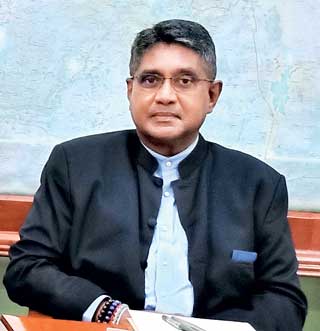
Editor’s Note: November 2, 2025, marks the beginning of the 48th year in journalism of veteran journalist M.R. Narayan Swamy, author of Tigers of Lanka, Inside an Elusive Mind, and The Rout of Prabhakaran.